SUCCESS STORY

Summary
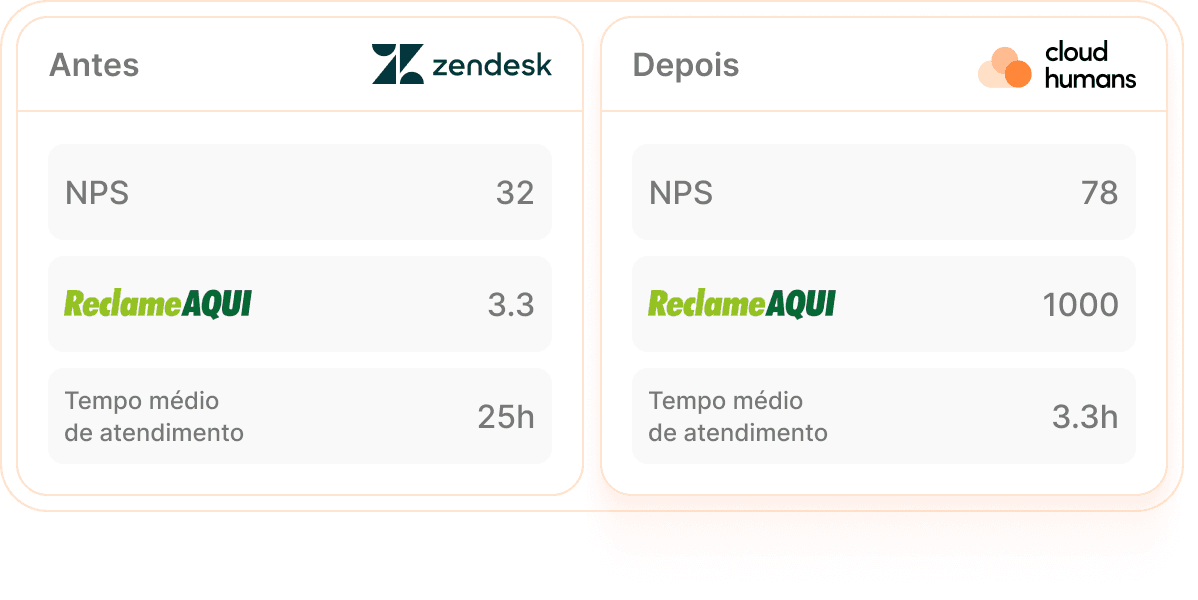
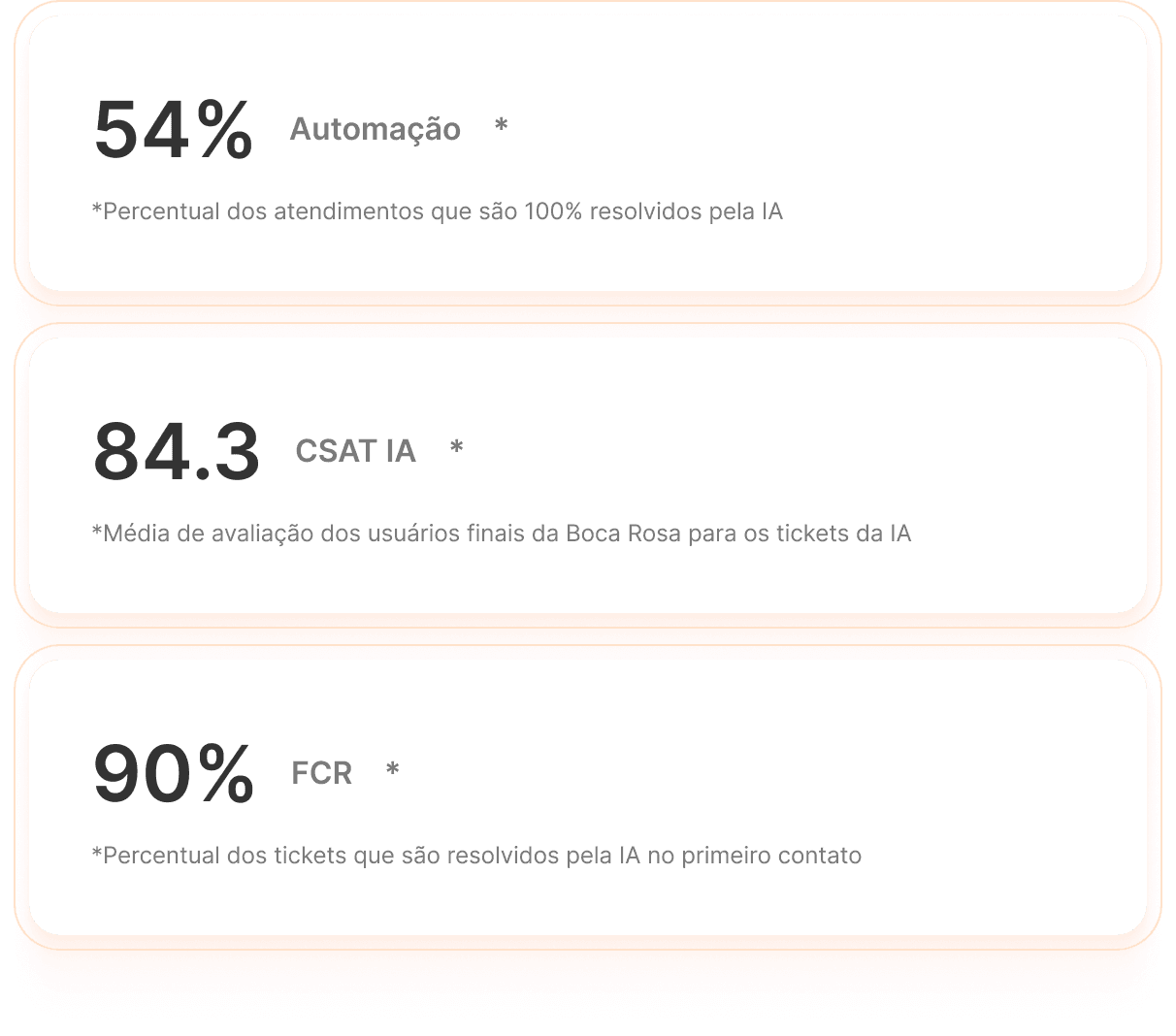
When Boca Rosa experienced a post-live crisis spike (high volume, integration and quality issues), customer service became a bottleneck and the brand's reputation took a hit: NPS 32, Reclame Aqui 3.3 and TMA of 25 hours. With Cloud Humans' AI (Rosa, the brand persona), the team regained performance and customer trust: in 6 months it reached NPS 78, earned RA 1000, reduced the TMA to 3.3 hours, raised AI CSAT to 84.3 and automated 54% of tickets — even with 80% of contacts being logistics.
“Boca Rosa has a huge name. The end-to-end operation was less than a year old. The expectations were enormous.”
Victor Xavier
Head of CX
The challenge: when the buzz is huge and the experience can’t keep up, the queue explodes
Boca Rosa Company began operating 100% “solo” end-to-end starting in October of the previous year (and B2B in January). In June 2024, a livestream generated a lot of revenue and expectations — and then came the combo nobody wants:
Integration issues and order updates
Cases of defective products/packaging
Digitally native consumers demanding an immediate response
Demand spikes in a lean team
Impact before AI (at the peak of the crisis):
NPS 32
Reclame Aqui 3.3 (not recommended / red)
AHT 25 hours
FCR 7/10 (3 out of 10 came back)
At one point, the company made a rare decision:
pause operations to fix what needed to be fixed and reconnect with the community
“A post-sales crisis is the same as a high volume of contacts + a misaligned experience.”
— Xavier
Why AI has become inevitable
In a digital-native brand, a “boxy chatbot” destroys identity.
The team needed to scale without becoming generic support.
What was at stake:
Keep the “Boca Rosa way” of speaking
Deliver agility and empathy during seasonality (launch = spike)
Get the team out of conveyor-belt mode (copy and paste)
Free up space for CX to influence the business (social, e-commerce, supply)
“I could scale with a boxy chatbot, but I would lose Boca Rosa’s personality.”
Victor Xavier
Head of CX
What made the difference in building Rosa
1) Start small and map frictions (real Pareto)
They already had a very clear picture of where it hurt most: post-live spikes, logistics making up 80% of demand, anxiety over status, and a digital-native customer with no patience for a long SLA. So AI came in first where it truly made a difference:
tracking
order status
repetitive questions clogging the queue
triage and pre-collection of data
2) Minimum viable content, with curation
Boca Rosa didn’t need a “perfect center” to get started. It needed a useful V1, aligned with the brand’s way of speaking and with the topics that came up most during crises.
What went in at the beginning:
answers about logistics and timelines
support policies and workflows (exchange, return, damage)
common exceptions at launch
empathy and transparency messages (without turning into a robot)
3) Continuous auditing with a clear owner (this speeds things up a lot)
Another point almost everyone ignores: having someone from CX as the owner of the audit changes the game. It’s not a “TI project.” It’s customer experience.
And when the owner is close to operations:
feedback becomes a short cycle
fixes are fast
the AI “ramps up” like a real person
4) Personality and voice tone (without destroying the branding)
Here there was an obvious requirement: you couldn’t scale with a rigid chatbot.
The AI needed to speak the way Boca Rosa speaks.
So the persona was designed to:
keep dynamism and connection
use emoji sparingly (and with context)
vary responses (so it doesn’t become a script)
mirror the customer’s tone when it makes sense
Xavier said something that sums it up well: there are customers who end the conversation without realizing it was AI — and that only happens when the language is human and consistent with the brand.
5) Integration to move beyond “FAQ” and become an agent
For me, this is the dividing line: chatbot answers. agent solves.
And in Boca Rosa’s case, since 80% of tickets are logistics, content alone isn’t enough.
The leap happens when AI can:
check updated status
pull tracking automatically
pre-collect data (photo, evidence, purchase info)
hand a “ready-to-handle” case to a human when escalation is needed
And this is exactly where AI becomes even stronger: connecting back office and taking repetitive “copy and paste tracking” work off the human’s plate.
Example of a real conversation
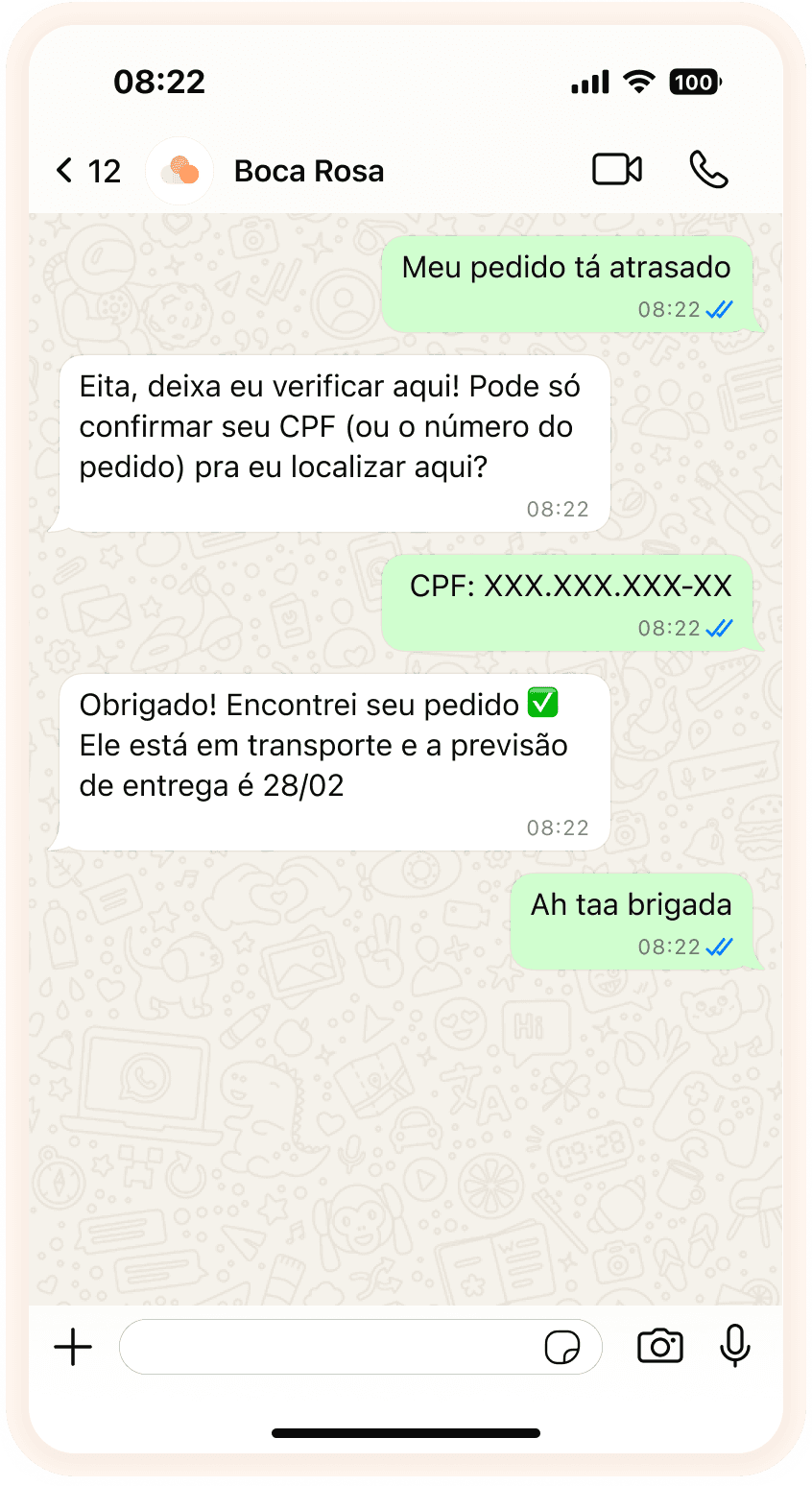
If you prefer, I can also transfer you to the human team right now to finalize any adjustment.
What’s happening behind the scenes:
status check via integration (logistics)
voice tone mirroring the customer (without overdoing the emojis)
clear handoff option
reduced public friction (fewer complaints on Reclame Aqui)
Key metrics
NPS: 32 → 78 (in ~6 months)
Reclame Aqui: 3.3 → RA 1000
TMA: 25h → 3.3h
FCR: 7/10 → 9/10 (only 1 return)
AI CSAT (Rosa): 84.3
Retention/automation: 54% (previous slide 44%)
Demand mix: 80% logistics
“Having 50% retention with 80% of tickets being logistics is very positive.”
Victor Xavier
Head of CX
How implementation went (step by step, concise)
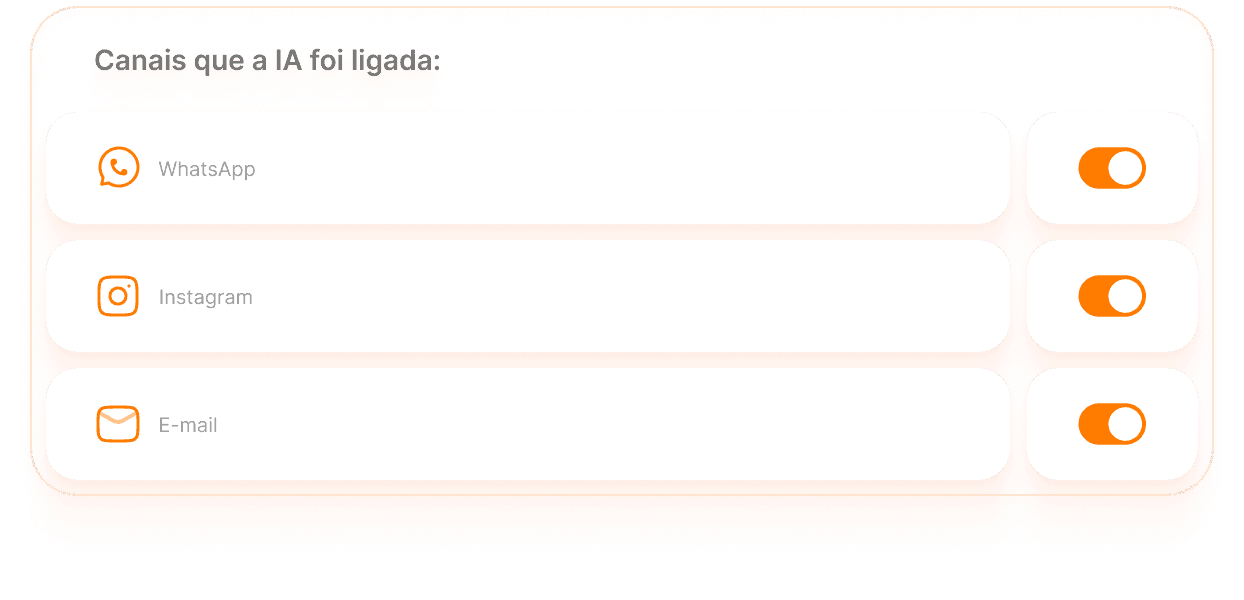
1️⃣ Setup and connection with the previous channel (without an in-house dev team)
Boca Rosa didn't have developers
Cloud Humans came in strongly as an implementation partner
Onboarding with close support
2️⃣ Persona and brand voice (Rosa)
native digital language
consistency with social/content
emojis in moderation
variable responses (not a “robot script”)
3️⃣ Continuous auditing (with an owner in CX)
dedicated person to train and fine-tune
analysis of what improves CSAT vs retention
easy feedback (like/dislike + correction)
4️⃣ Rules for sensitive cases
product quality
returns
adverse reaction
the AI recognizes and transfers transparently
5️⃣ Eddie in the back office (logistics and editing)
integration with the logistics operator and purchase data
tracking automation
next step: profile updates (email/address) without a human
“Rosa already asks for a photo, data, and context. By the time it reaches a human, it arrives fully prepped.”
Victor Xavier
Head of CX
WHAT CHANGED THE GAME: From AI in Zendesk to the complete Cloud Humans solution (AI + Cloud Chat)
An important point in Boca Rosa’s journey: in the beginning, Rosa ran integrated with Zendesk.
It worked.
But it wasn't ideal.
Over time, it became clear that it made more sense to use Cloud Humans’ full solution — AI + Cloud Chat in the same ecosystem.
“The best decision I made was to use Cloud Humans’ full solution. AI + helpdesk in the same place changed the game for us.”
Victor Xavier
Head of CX
What changed in practice
1️⃣ Real WhatsApp (without brokers)
In Zendesk: we had to work with brokers because the tool was not natively built for WhatsApp.
In Cloud Chat: official WhatsApp integrated directly, no hacky workaround.
2️⃣ Simpler tool
Zendesk was complex and expensive for what we used.
Cloud Chat is more intuitive, easier for the team, and faster to operate.
3️⃣ More aligned pricing model
Zendesk charged for modules and add-ons, with long-term contracts.
Cloud Humans has a more predictable model with no “gotchas.”
4️⃣ Much closer support
With Zendesk, support was distant and frequently pushed us toward expensive third-party consulting.
At Cloud Humans, implementation and follow-up were done in true partnership.
5️⃣ Easier-to-train AI
The AI inside Zendesk was more complex to maintain.
Rosa is easy to audit, adjust, and improve — directly through the interface.
The result wasn't just technical.
It was operational.
The side effect I like most: the human team becomes strategic
When repetitive work disappears, the team stops surviving and starts building.
What started to fit into the schedule:
group delight initiatives
customer voice committee
rituals with social, supply, and e-commerce