SUCCESS STORY

Understand how Linus prepared its customer service for the months of highest demand, scaled with quality, and transformed a reactive operation into a more stable structure with the help of AI.
Metric | Result |
|---|---|
Average retention | 60% |
CSAT with AI | 92% |
Target | 2026 achieved ahead of schedule |
About Linus
Linus is a Brazilian sustainable lifestyle brand, with vegan and recyclable products, and treats CX as a central area for the brand's reputation and customer loyalty.
Internally, customer service is seen as a critical part of the experience, with a direct impact on the results of marketing, logistics, and the other departments.
During promotional periods, the volume of contacts could triple, putting pressure on a small structure at a sensitive point in the customer experience.
When peak traffic became a bottleneck for the experience
With a lean structure and a predictable peak in demand on the calendar, Linus needed to handle support that became more pressured precisely when the customer experience became more sensitive.
As demand increased, the operation accumulated bottlenecks that affected the team's pace, the fluidity between channels, and the ability to respond to customers.
Title | Description |
|---|---|
Huge support queues | The high volume of contacts increased wait times and put operations into a constant state of urgency. |
Duplicate protocols across channels | When support took too long, the customer moved to other channels looking for a response. This caused the operation to deal with the same case more than once. |
Complaints about slow support | Slowness stopped being an internal problem and began to affect the brand's reputation, with complaints registered on Reclame Aqui. |
Team stuck in reactive mode | The team was consumed by repetitive and urgent demands, with no time to build processes that would prevent new queues. |
In this scenario, Linus's challenge was to create a more stable operation, with less friction in support and greater responsiveness at times of highest pressure. The company needed to find a way to absorb the increase in demand without letting queues, rework, and bottlenecks between channels compromise the customer experience.
At the same time, this change needed to give the team more control back. The goal was not just to gain speed, but to structure an operation capable of responding more consistently, reducing the team's overload, and making room for a less reactive day-to-day approach.
“We didn't have time to be strategic or to build processes that would prevent new queues.”
Luiza Kravtchenko
CX Coordinator at Linus
AI as a solution to reduce friction and scale
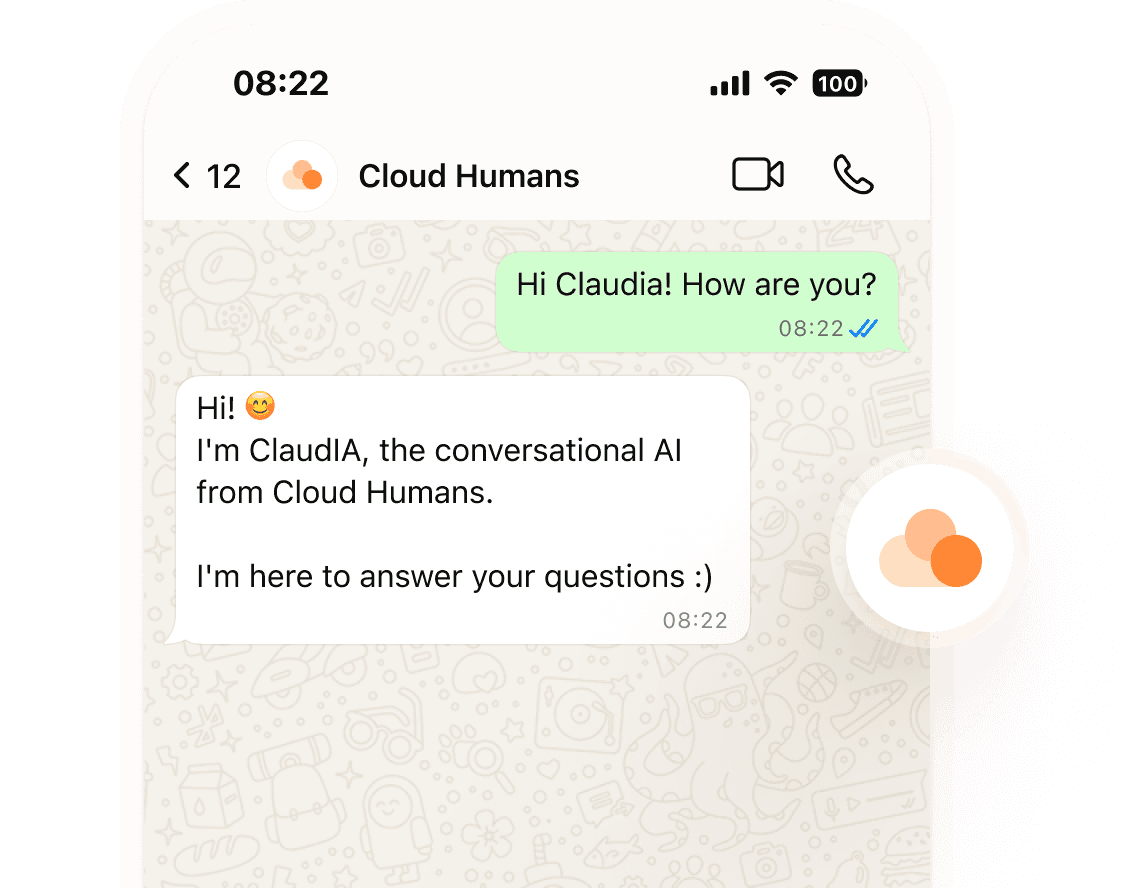
To handle peak periods with greater stability, Linus implemented Cloud Humans’ AI in its CX operation and gave it a proper name: Lina. The goal was to reduce the burden of repetitive requests, cut down on cross-channel rework, and prepare the team to respond better during periods of higher pressure.
Main changes:
A significant share of recurring questions began to be handled by the AI.
The team gained more room to focus on critical cases.
The operation became less dependent on manual effort to handle basic volume.
Support gained a more stable foundation for peak periods.
The team gained more ability to monitor, adjust, and evolve the experience over time.
The solution created a new foundation for support, with greater scaling potential and less dependence on manual effort for recurring requests. To capture this gain, the implementation needed to be fast, close to the operation, and guided by constant adjustments.
“AI came in to make the team more strategic, the operation healthier, and support more scalable.”
Luiza Kravtchenko
CX Coordinator at Linus
How the new operation took shape in practice
Lina's implementation happened with some urgency and within a strategic window. Instead of waiting for the main year-end peak, Linus used September as a laboratory to put the AI into operation, measure its efficiency, and arrive in November with a better-prepared foundation.
This process required a quick migration, channel enablement, and a close monitoring routine. More than just getting the AI live, the priority was to make it evolve quickly within the operation.
Stage | Title | Description |
|---|---|---|
01 | The laboratory | Linus decided to bring the implementation forward to test Lina during a high-volume period (September) and use that time to understand what still needed to be adjusted before the year’s most critical peak. |
02 | The migration and accelerated pace | The change happened in a short time. The operation left the previous platform and, the very next day, already needed to enable Cloud Chat and the necessary channels to get the new structure live. |
03 | AI auditing and monitoring | From the start, the auditing routine became a priority. Linus began reviewing protocols, monitoring responses, identifying failure points, and understanding what needed to be corrected so Lina could evolve more quickly. |
04 | Lina's day-to-day evolution | With Geovanna, a CX analyst, leading the audits and constant adjustments, the AI began to better incorporate the brand’s tone, the context of conversations, and the nuances of support. |
The implementation was not treated as an isolated technology project. It was carried out as part of the operation's routine, with close monitoring, constant adjustments, and a clear sense of priority. This model made Lina evolve faster and allowed Linus to turn an urgent deployment into a more solid foundation for the months of greatest pressure.
There's also an important detail here: the AI's evolution depended less on a robust technical structure and more on operational clarity, auditing, and service knowledge. It was this combination that helped Lina speak Linus's language more and more.
“Sometimes we, as a client, don't know exactly how to say what we want, but I told our story and Cloud Humans, with its AI expertise, translated it into a process.”
Luiza Kravtchenko
CX Coordinator at Linus
What changed with Lina in operation
With Lina up and running and a routine close to auditing, Linus began to capture concrete gains both in the metrics and in the team's dynamics. The progress showed up in retention, customer satisfaction, and the operation's ability to get through periods of higher pressure with more stability.
Metric | Result | Impact |
|---|---|---|
Average ticket retention | 60% | More resolution without expanding the team at the same rate. |
Average CSAT | 92% | Scaling while maintaining perceived quality. |
The numbers help size the result, but the impact of the implementation also became visible in the day-to-day routine of the operation. Lina started with about 39% retention in September, improved to 41% in October, and reached 60% in November, showing that the combination of technology, auditing, and fine-tuning generated progressive gains over the months.
At the same time, Linus began operating with less friction during high-demand moments, with a reduction in duplicate protocols, the end of red flags on Reclame Aqui due to delays, and a more positive perception from the team about the area's routine. Instead of merely absorbing volume, the operation gained more predictability and more room to act where human intervention generated more value.
“In six years, it was the first time I felt a lighter atmosphere in the area.”
Geovanna Silva
CX Analyst at Linus
What Linus learned by putting AI into operations
Topic | Description |
|---|---|
AI learns from those who live customer support | The quality gain depends on the expertise of those who know the recurring questions, understand the customers' context, and can adjust content, intent, and language based on real conversations. |
Continuous auditing is part of the result | Lina's evolution came from frequent review of conversations, term adjustments, creation of new content, and calibration of responses. This is what made it possible to turn a quick implementation into a more precise operation over time. |
AI changes the team's way of working | In practice, AI took the weight off repetitive tasks and opened space for more analytical and strategic activities. Instead of centering the routine on volume, the team began to dedicate more energy to improving operations, reading patterns, and evolving the experience. |
The impact shows up in the numbers, but starts in the day-to-day | Results in retention and CSAT are relevant, but the effect goes beyond that: less overload, more predictability, and a lighter operation for those on the front lines every day. It was this change in routine that sustained the improvement in the metrics. |
Cloud Humans answers
Was Linus already using automation before Lina?
Yes. The company already had experience with bots, but was still looking for a smoother operation, with more natural responses and more capacity to handle peak periods without increasing friction in support.
What motivated the change in operations?
The main trigger was the combination of a lean structure and predictable demand spikes, such as when volume increased, the operation built up queues, duplicate protocols appeared, and the team lost room to act with more control over the daily routine.
Did AI replace people on the team?
No. The role of AI was to absorb a significant portion of repetitive demands and open space for the team to work on the most critical cases, operational improvement, and the evolution of the experience itself.
What does this case show other CX operations?
That AI in customer support works best when it is part of an operational change. The result depends on timing, close monitoring, and the team's ability to teach the AI based on real daily operations.