SUCCESS STORY

The strategic decision behind Yampi's case: initial challenges, implementation, results, and lessons you can take away. Understand how it reduced response time and redistributed the team to higher-value roles within operations.
Metric | Result |
|---|---|
Time to first response | 20s |
Satisfaction in interactions with AI | +90% |
AI-resolved cases | +70% |
About Yampi
Yampi is a Brazilian e-commerce technology platform that helps merchants create, run, and scale their online sales. Founded in 2011, the company has already supported more than 170,000 merchants, from small entrepreneurs to large operations that generate millions per month.
This diverse customer profile makes support a central part of the experience offered by the platform. Support is provided mainly via chat, a channel in which response speed has a direct impact on the perception of service quality.
How can you scale customer service without losing speed?
With the growth of Yampi's merchant base, the volume of support interactions increased rapidly. Since chat is the main service channel, customers have always expected quick responses, and this began to become difficult to sustain with the traditional model, which was already showing flaws.
Title | Description |
|---|---|
High response time | The time to first response could exceed 50 minutes, creating support queues and impacting the customer experience. |
Operation 100% dependent on the human team | Even with around 15 to 20 people in support, on peak days everyone had to take calls to handle the volume of interactions, including leadership. |
Growth would require doubling the team | Internal projections showed that, to sustain growth while keeping the same model, support would need to expand to 40 to 44 analysts. |
Large volume of recurring questions | A significant share of interactions involved repetitive operational questions, which followed predictable response patterns and consumed the team's time. |
Yampi's challenge was not just to respond faster. It was to find a way to absorb the growth in the customer base without depending on a proportional increase in the team, while maintaining the quality of the experience and freeing specialists for interactions that really required human context.
“If everyone took a complex issue at the same time, nobody answered the new tickets and response time reached up to 50 minutes.”
Jessé Lopes
Chief Operating Officer at Yampi
The challenge, therefore, was not just to serve more. It was to create an operation capable of scaling efficiently, preserving the human touch at the right moments and sustaining the company's growth without turning customer support into a limitation on the business itself.
AI as an extension of the customer support team
Given the growth of the operation and the pressure on support, Yampi decided to test a new approach: incorporating AI agents as part of the customer support team, working directly in interactions with customers.
The goal was not to replace the human team, but to create a hybrid structure in which AI would absorb much of the recurring operational questions while analysts focused on the more complex cases.
Key changes:
The operation began to use AI agents trained on the support history and Yampi's context.
AI took over much of support's operational and repetitive questions.
Support started to operate in a hybrid model between AI and human specialists.
The team was redistributed. People who had previously been exclusively on the front line began working in CS, onboarding, revenue operations, retention, and services.
Yampi began tracking indicators such as first response time, CSAT, retention rate, and requests to transfer to a human in near real time.
“The idea was never to replace the team, but to use AI to absorb recurring questions and free people up for what really requires analysis and context.”
Jessé Lopes
Chief Operating Officer at Yampi
Building a hybrid operation between AI and experts
The implementation of AI in Yampi's support operation happened gradually. The goal was to incorporate the technology without compromising the customer experience and while ensuring the human team continued handling the most complex cases.
The process involved adjustments both in the technology and in the service structure itself, as described in the phases below.
Stage | Title | Description |
|---|---|---|
01 | Structuring support by tiers | Before the introduction of AI, Yampi had already reorganized support into two levels of service: N1, responsible for recurring operational questions; and N2, dedicated to more complex issues. This did not solve the problem completely, but it slightly reduced response time and served as the basis for introducing AI in the first layer of support. |
02 | Training the AI with support history | The AI agents were trained using the real history of support interactions, allowing the system to learn the most common question-and-answer patterns within the platform. This process was essential to ensure more consistent responses aligned with the context of Yampi's operation. |
03 | AI taking over the first layer of support | With the initial training completed, AI began acting as the first layer of support, answering operational questions and collecting information before escalating more complex cases to the human team. This model made it possible to significantly reduce the volume of tickets that reached specialists directly. |
04 | Continuous evolution of the operation | The operation continued to evolve based on real interactions with customers. The CX team began monitoring conversations, adjusting responses, and expanding the AI's repertoire as new scenarios emerged. This process made it possible to continuously improve the quality of responses and broaden the scope of interactions that could be resolved by AI. |
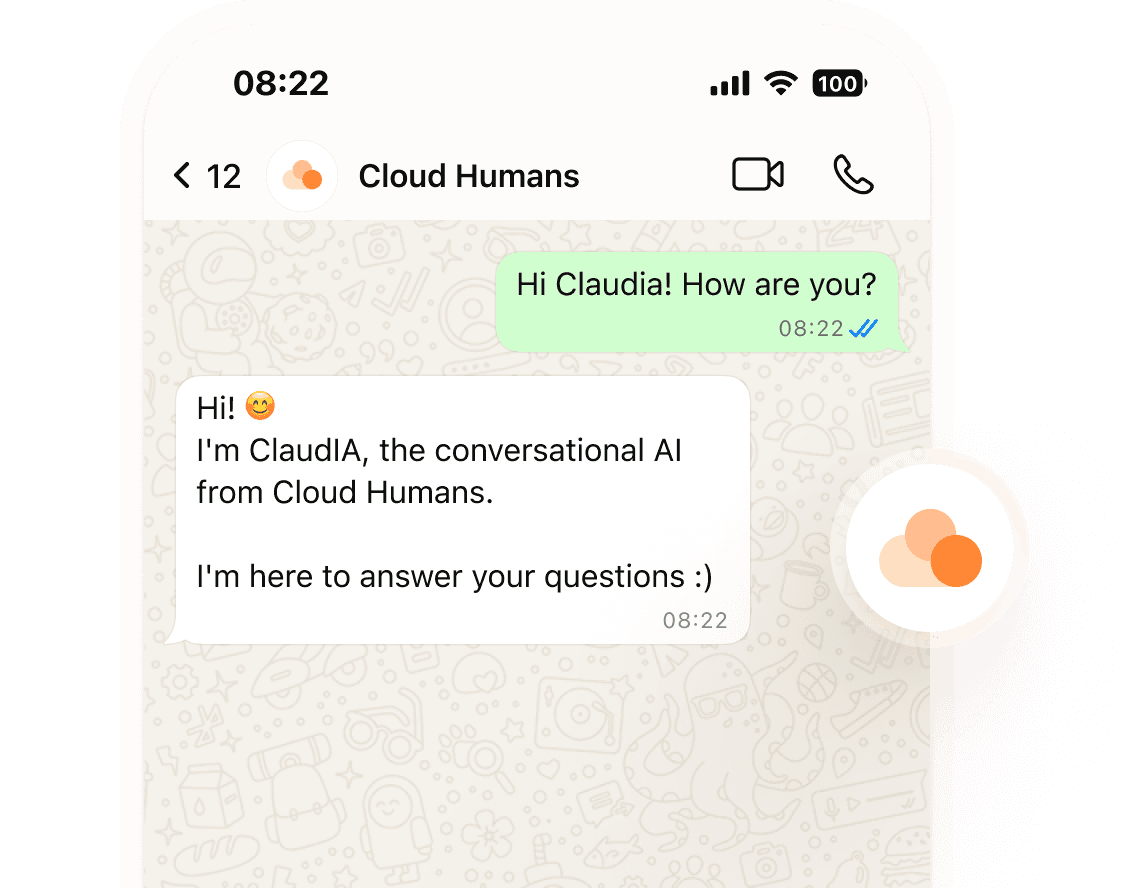
From the start, Yampi chose not to treat artificial intelligence as a bot or an isolated automation layer. The assistant was positioned as a real part of the support team, with a name, visual identity, and a clear role within the operation.
The AI was presented to customers as a team member, not as a technological barrier. The logic was simple: if the interaction solves the problem quickly and well, the customer's perception tends to be positive.
After establishing ClaudIA as the front line in support, Yampi moved on to a second operational layer.
Eddie, Cloud Humans' backoffice agent, was added to expand the AI's resolution capacity.
Through it, the assistant began to consult and update information in internal systems, such as ERP, logistics systems, and the e-commerce platform itself.
This evolution made it possible to reduce unnecessary transfers to human support and further increase the operation's automatic resolution rate.
Transformation into numbers
With the introduction of AI into support operations, Yampi was able to drastically reduce response time and absorb a large share of interactions directly through automation. The hybrid model between AI agents and human specialists made it possible to scale support without the need to grow the team at the same pace. The results were seen both in operational efficiency and in customer experience.
Metric | Result | Impact |
|---|---|---|
First response time | 50min → 20s | Immediate response in the main support channel. |
CSAT in AI interactions | +90% | High satisfaction levels, even with automated interactions. |
Retention / Resolution by AI | 74,9% | AI began absorbing a large share of interactions without escalation (+23 thousand cases). |
AI adoption fundamentally changed Yampi's support operation. First response time dropped from peaks of over 50 minutes to less than 20 seconds, while retention surpassed 74% and AI CSAT remained above 90%.
In addition to absorbing more than 23,000 tickets in five months, the new operation began running 24 hours a day and generated a projected savings of nearly R$ 1.5 million per year, without needing layoffs and without any loss in service quality.
“Today, we have more than 70% of interactions resolved without needing human support.”
Jessé Lopes
Chief Operating Officer at Yampi
What Yampi learned by implementing AI in customer service
Topic | Description |
|---|---|
What Yampi learned by implementing AI in customer support | The goal was never to remove people from the operation, but to redistribute the work so that AI would handle recurring questions while the human team focused on cases that require analysis and context. |
Automating recurring questions frees the team for real problems | Most support interactions followed predictable patterns. By transferring these questions to AI, the team was able to dedicate more time to complex and strategic support. |
Scaling support with people alone is not sustainable | Projections indicated that the team would need to nearly double in size to keep up with the growth of the customer base. Automation made it possible to absorb this increase without expanding the team proportionally. |
AI needs to evolve along with the operation | Continuous monitoring of interactions and adjustments to AI responses were essential to gradually expand the types of support that could be resolved automatically. |
Cloud Humans answers
Did AI replace Yampi's support team?
No. AI began to act as the first layer of support, handling operational and recurring questions. As a result, the human team started focusing on more complex interactions and strategic activities within the operation.
How long did it take to implement AI in support?
The initial implementation took about a month, including preparing the knowledge base, training the model with historical conversations, and operational adjustments in the support team.
What was AI's impact on support speed?
First response time dropped from peaks above 50 minutes to less than 20 seconds after introducing AI into support.
What was AI's impact on operational efficiency?
Automation allowed most interactions to be resolved without escalation to the human team. In addition, the operation began to run 24 hours a day and generated an estimated operational savings of around R$ 1.5 million per year.