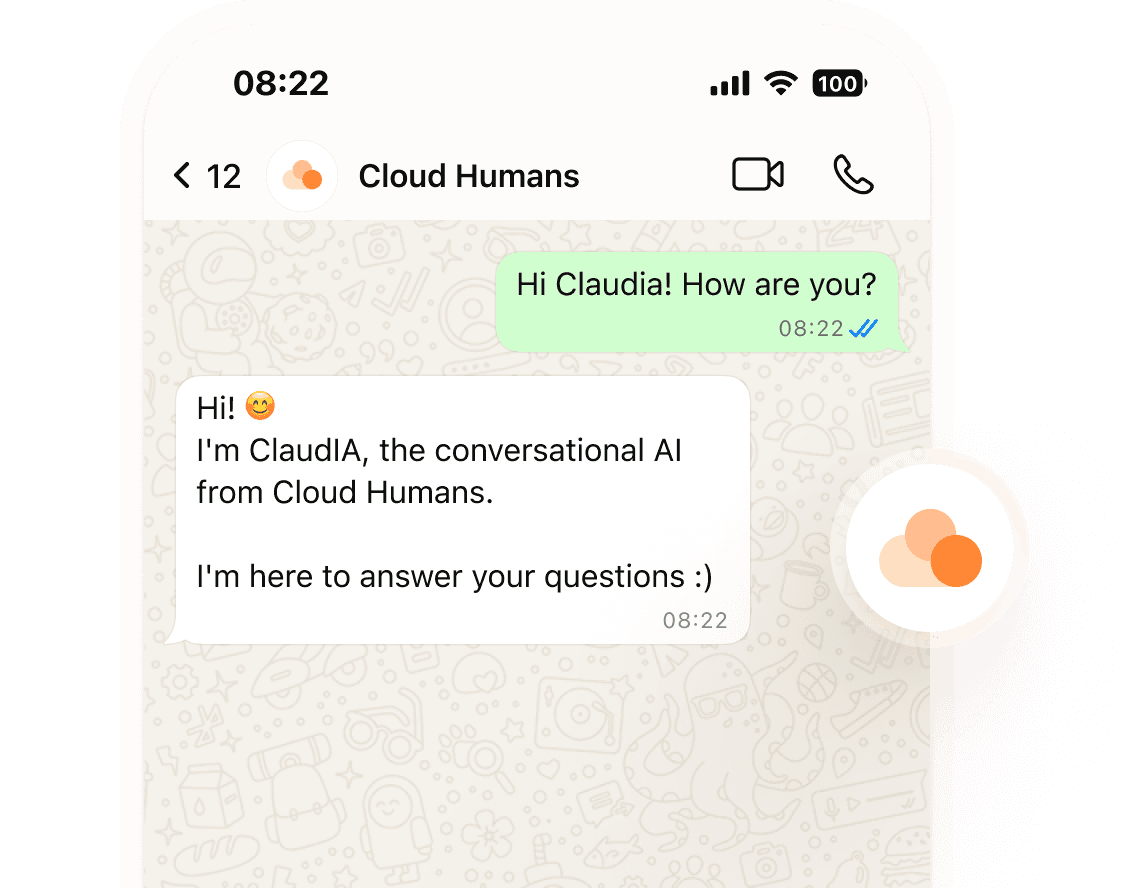
Cloud Humans vs Blip
Updated on: February 10, 2026 • By: Bruno Cecatto • Reading time: 6 min
Quick answer
If your only goal is to create controlled and highly routed flows within WhatsApp, especially for commercial use, Blip can work well.
If you want real conversational AI, complete omnichannel helpdesk, and close support to implement and evolve the operation, Cloud Humans tends to be the simplest, most efficient, and sustainable choice in Brazil.
Summary
If you want to use conversational AI that understands natural language → Cloud Humans
If your focus is on building controlled decision tree flows → Blip
If you need to centralize WhatsApp, email, chat, and social media in one place → Cloud Humans
If you just want to operate WhatsApp with high flow customization → Blip
If you don’t want to depend on third-party consultancies to evolve → Cloud Humans
If you are looking for a complete omnichannel support platform → Cloud Humans
If you seek economic incentives aligned with efficiency and results → Cloud Humans
Recommended next step: before deciding on any tool, run a diagnostic of automation potential. Cloud Humans provides this for free and without obligation.
Where Blip is strong
Blip has established itself as a very strong platform for companies that:
Have intensive WhatsApp usage
Want to build highly controlled flows
Operate sales journeys with specific routing
Need complex decision trees
The Builder module allows you to create structured flows, with menus, numbered options, routers, and conditional rules.
For scenarios where the goal is to have total control over the journey, this works well.
But the model is based mainly on structured flows, not fluid conversation.
AI: structured workflow vs conversational agent
This is the main difference.
In Blip, you build flows.
Even with more advanced features, the predominant logic is still:
Press 1 for...
Press 2 for...
This generates control.
But it also generates friction.
In Cloud Humans, the logic is different.
Instead of relying on extensive decision trees, you use a conversational AI agent, which:
Understands natural language
Interprets intent
Leads the conversation fluidly
Drastically reduces the need for complex flows
In practice, this means less maintenance, less complexity, and less reliance on technical specialists.
While Blip offers the Builder to structure paths, Cloud Humans offers an AI that talks like a human.
For companies that want to reduce friction and increase the rate of automatic resolution, this changes the game significantly.
Omnichannel: isolated WhatsApp or a complete operation?
Another critical point.
Blip is essentially a platform centered on WhatsApp.
It was not born as a full omnichannel helpdesk.
Companies that need to integrate:
Email
Web chat
Social media
Unified ticket management
They usually end up needing to contract parallel tools such as HubSpot, Zendesk, or other customer service platforms.
This adds:
Cost
Complexity
Extra integrations
Multiple contracts
At Cloud Humans, WhatsApp is native and advanced, but within a complete omnichannel helpdesk platform.
You can operate:
Reactive and proactive WhatsApp
Chat
Email
Social media
All in the same environment. With AI integrated at the front line.
Without needing to assemble a tool stack.
Pricing model: usage or results?
WhatsApp is the main service channel in Brazil.
This is a strategic point that few companies analyze before hiring.
The traditional Blip model is primarily based on:
MAU (monthly active users)
Volume of interactions
In practice, this means:
The more you use, the more you pay.
Regardless of the outcome.
If the flow is poorly structured and generates more interactions than it should → you pay more.
If the journey is confusing and the customer needs to interact multiple times → you pay more.
If your operation grows → you pay more.
The economic incentive is not necessarily aligned with efficiency. It is aligned with volume.
What does this mean in practice?
In an interactions-based model:
It doesn't matter if the AI solved it on the first contact
It doesn't matter if the journey was efficient
It doesn't matter if there was rework
It doesn't matter if the conversation was long or short
The cost grows with usage.
The more messages and interactions there are, the higher the charge. Even if part of that volume is generated by poorly structured flows or unnecessary friction.
At Cloud Humans, the model is different.
Pricing is based on tickets retained by the AI.
That is:
Cases that are routed to a human are not charged as automation.
You only pay for the cases the AI actually resolves.
This completely changes the economic incentive.
If the AI resolves more → you reduce human workload
If you reduce human workload → you reduce the need for support positions
If you reduce the need for positions → you reduce structural cost
If automation improves → your efficiency grows
There is no incentive to generate more interactions.
There is an incentive to resolve better and retain more tickets.
That's why many companies report something interesting:
Sometimes the monthly absolute value of Cloud Humans and Blip may seem similar.
But the difference shows up in the outcome.
With Cloud Humans, the chatbot tends to resolve significantly more.
And when it resolves more, the company saves on support and sales positions.
The billing model becomes aligned with operational efficiency.
In the long run, this alignment matters more than the nominal contract difference.
Implementation and support: where the experience changes
This point rarely appears in comparisons.
Blip's business model tends to favor large companies with high volume.
These usually receive better direct attention.
Medium and small companies, on the other hand, are often directed to third-party consultancies to implement and evolve the project.
These consultancies do not always fully master the product. And the incentive is not always fully aligned with long-term operational performance.
At Cloud Humans, support and implementation are a central part of the offering.
The company:
Dedicates its own team to implementation
Acts as a close partner to operations
Helps continuously improve automation
Does not require you to master complex workflows
Since the logic is based on conversational AI and not on extensive trees, management tends to be simpler and less dependent on external specialists.
Read also
Find other content
Cloud Humans vs building in-house (Build or buy?)
Cloud Humans vs Octadesk