SUCCESS STORY
See how Contraktor scaled support in a multi-product operation, reduced the backlog accumulated outside business hours, and freed the team to focus on what really required human intervention.
Metric | Result |
|---|---|
Tickets resolved with AI | 75% |
First response time | 15s |
Chat backlog in the morning | 0 |
About Contraktor
Contraktor operates in the contract management market and has been expanding its operation with different products within this ecosystem.
As a result, the company needs to serve both direct customers and end users who interact with the platform to sign contracts and complete steps in the process.
In practice, this increases the volume of questions, the variety of support tickets, and the pressure for quick, accurate responses. Scaling support without losing efficiency has become an increasingly clear necessity.
The main bottlenecks of the operation at that time
As the operation evolved, Contraktor began to face a common challenge in SaaS companies with a broader portfolio: maintaining speed and quality in support without turning support into an increasingly heavy structure.
Title | Description |
|---|---|
High volume of repetitive tickets | A large part of the operation was consumed by recurring questions, which overloaded support and took time away from cases that required more context and analysis. |
Multiple products, more complexity | With different product lines in operation, the team had to handle different journeys, workflows, and knowledge bases within the same support interaction. |
Pressure for speed without losing quality | It was necessary to respond quickly in a sensitive context, without compromising clarity and security in interactions related to contracts and subscriptions. |
Scale without inflating the structure | As the operation grew, it became clearer that expanding the team at the same pace would not be the most efficient or sustainable path. |
Contraktor also tested a few tools in an attempt to scale support. First Intercom, which offered robustness, but its dollar-based, per-ticket pricing was too heavy for a high-volume operation.
Then, the company tried Crisp, which was more affordable, but still did not deliver the depth and retention needed in AI-powered support. In practice, the challenge remained unresolved.
“With the evolution of the operation, we began to feel an increasingly greater complexity on the support side.”
Rafael Salomão
Head of Customer Success at Constraktor
ClaudIA as the new scaling layer for support
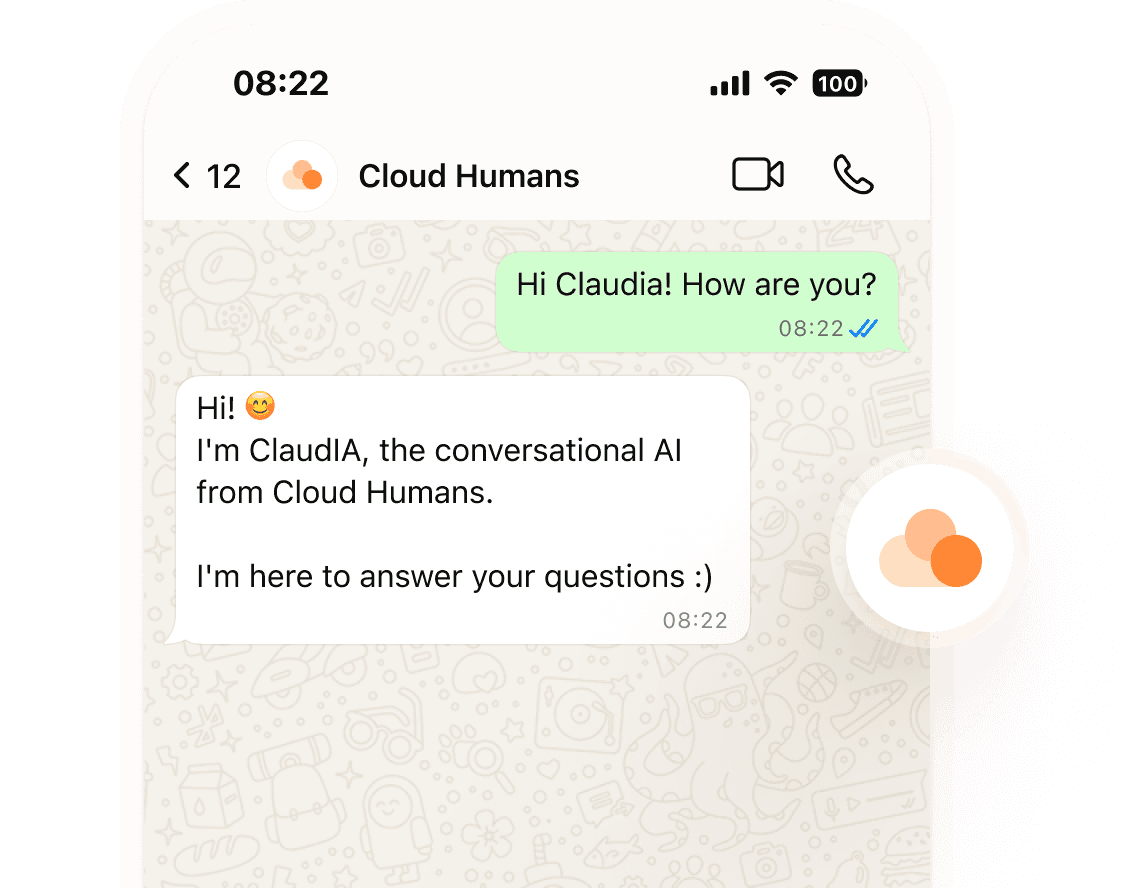
Contraktor's answer was to structure the initial support with ClaudIA, using AI to absorb N1, handle recurring questions, and make ticket intake smoother.
Main changes:
ClaudIA began handling the first contact with the customer, reducing the burden of manual support right at the start of operations.
While the AI handled recurring questions and initial triage, the human team focused more on cases requiring analysis, context, and greater depth.
The operation became less dependent on the team's attention being split across different platforms, resulting in more consistent support.
The Help Center and existing workflows began feeding the AI, enabling faster responses aligned with the operation's context.
The operation gained more balance, more speed, and a more efficient way to scale without increasing the structure proportionally
“While we're giving attention to a more serious case, ClaudIA can handle the support right at the beginning.”
Alana S. Souza
Senior Support Analyst at Constraktor
Fast implementation, continuous evolution
The implementation of ClaudIA happened much more simply than the team had imagined at the beginning. Instead of requiring a parallel structure or a major technical mobilization, the project relied on a foundation that Contraktor already had: its support content, workflows, and the operation’s hands-on experience.
Step | Title | Description |
|---|---|---|
01 | Initial base built from real operations | The Help Center, the existing workflows, and the team’s knowledge served as the starting point for structuring ClaudIA’s responses and behavior. |
02 | Fast entry with validated rollout | In about a week, the AI was already live on Constraktor Sign. Based on the learnings from this stage, Constraktor expanded ClaudIA to the other support areas. |
03 | Calibration in the first weeks | After go-live, the team monitored conversations, reviewed responses, and refined ClaudIA’s performance to increase alignment, quality, and retention. |
04 | Evolution with close support and auditing | The implementation did not end at setup. The maturity gains came from ongoing monitoring, audits, and the team’s dedication over the first few months. |
More than an implementation project, ClaudIA’s launch was treated as an operational evolution process. The setup was fast, but the results came from the combination of a well-structured foundation, constant calibration, and direct involvement from those who knew the support routine.
With the close support of Cloud Humans and the active participation of the Contraktor team, the operation gained maturity without interrupting day-to-day support.
“The implementation was also very smooth. I can say that I had a lot of support from the entire Cloud Humans team from the very beginning.”
Alana S. Souza
Senior Support Analyst at Constraktor
The results of ClaudIA in the operation
With ClaudIA handling initial support, Contraktor began to see clear gains in speed, resolution, and operational efficiency. The results showed up both in the most visible metrics, such as first response time and AI retention, and in the team’s day-to-day routine, which began to operate with less overload and more room to work strategically.
Metric | Result | Impact |
|---|---|---|
Tickets resolved by AI | 75% | More support capacity without increasing the structure at the same rate |
Backlog at the start of the day | 30 chats → 0 | Less queued-up backlog and a lighter start to operations |
First response time | 40 min → 15s | Almost immediate response as soon as support begins |
In addition to the results shown in the table, the change also became clear when compared with previous attempts in the operation. Before Cloud Humans, Contraktor had already used Intercom and Crisp, but had still not found a truly efficient combination of cost, AI quality, and support retention capability. In the case of Crisp, for example, the operation did not reach 15% of support via bot.
The gain also appeared in the way the operation became less dependent on the technology team in some routines. With the evolution of the implementation and the use of integrations with backoffice, Contraktor gained more autonomy to resolve part of the demands that previously required direct technical support.
“We were able to use her time for things that were truly more strategic.”
Rafael Salomão
Head of Customer Success at Constraktor
What Contraktor learned in the process
Theme | Description |
|---|---|
Good implementation depends on the tool and a committed team | The result didn’t come from technology alone. The combination of a good solution and an engaged team was essential to make the implementation truly work. |
Automation doesn’t replace the team, it frees the team | With ClaudIA absorbing part of the initial support, the human team gained more room to focus on what required analysis, context, and strategic action. |
Gaining efficiency in N1 changes the entire operation | When initial support becomes faster and more efficient, the impact goes beyond the queue: the operation becomes smoother, the team works better, and the customer feels the difference. |
Continuous tuning makes AI evolve with the operation | Going live quickly was important, but the best results came from constant follow-up, conversation reviews, and adjustments made in the first few weeks. |
“A good tool and a committed team make a good implementation. You can’t expect a miracle from the vendor alone.”
Rafael Salomão
Customer Success Head at Constraktor
Cloud Humans answers
What was Contraktor’s main challenge before ClaudIA?
Contraktor needed to maintain speed and quality in support across an operation with multiple products, repetitive tickets, and an increasingly complex knowledge base, without expanding the team at the same pace.
How did ClaudIA start operating in the workflow?
ClaudIA took over initial support, handling N1, dealing with recurring questions, and routing cases that required more analysis, context, or depth to the human team.
Was the implementation complex?
No. The implementation went live quickly and built on a foundation that Contraktor already had, such as support content and operational workflows. The increase in maturity came with continuous tuning in the following weeks.
How long did it take for the operation to start seeing results?
The AI was already live for testing in about a week. After that, the adjustments and audits in the first few weeks helped accelerate the operation’s improvement curve.
Did ClaudIA only solve simple questions?
No. In addition to absorbing initial support and recurring questions, the operation also evolved with integrations and workflows that expanded the AI’s capability within support.