Decision tree chatbots tend to work better for simple and predictable questions, with little variation and no need for context. AI agents make more sense in operations with high volume, multiple exceptions, and the need to resolve cases from end to end.
If you are evaluating the use of chatbots to improve your company's customer service, understanding which model is right for your scenario is essential to avoid generating the opposite effect. Instead of gaining efficiency, a wrong decision can create more friction, overload the team, and compromise the customer experience.
This impact appears even more quickly in critical channels, such as WhatsApp, which is preferred among users in Brazil and where the expectation for responses is immediate. With high contact volumes, the human team continues to absorb a good part of the customer service, operational costs increase, and the customer becomes frustrated with rigid responses.
When each approach makes more sense:
Decision tree chatbots work well when there are simple and repetitive questions, small or slightly variable catalogs, few exceptions, low integration needs with systems, and when a limited coverage is acceptable.
AI agents make more sense when there is a high volume of customer service, a large variety of cases and exceptions (edge cases), WhatsApp is a critical channel, and there is a need to understand context, execute actions, and evolve with use.
In practice, the most common path in real operations is to start with a clear focus (top intents), measure retention, escapes, and quality, and scale progressively, with governance.
What is a decision tree chatbot?
A decision tree chatbot is an automated service system based on pre-defined flows. It guides the user through a sequence of questions and answers, usually in the form of buttons or menus, until reaching a specific outcome. Each choice leads to a new path, like in a flowchart.
This type of chatbot does not understand the context nor “interprets” the customer's message. It merely executes rules: if the user chooses A, it follows the A flow; if they choose B, it goes to the B flow. Everything the bot responds needs to have been previously mapped, written, and maintained by someone on the team.
What is an AI agent in service
An AI agent, unlike the previous model, understands the intention behind the message, considers the context of the conversation, and decides how to respond or act, even when the request is incomplete, out of order, or written differently than expected.
While traditional chatbots fail when the customer strays from the script and generates the “I didn’t understand” response, the AI agent can interpret variations in language, recall previously mentioned information, and maintain coherence throughout the conversation. The customer does not need to adapt to the bot; the bot adapts to the customer.
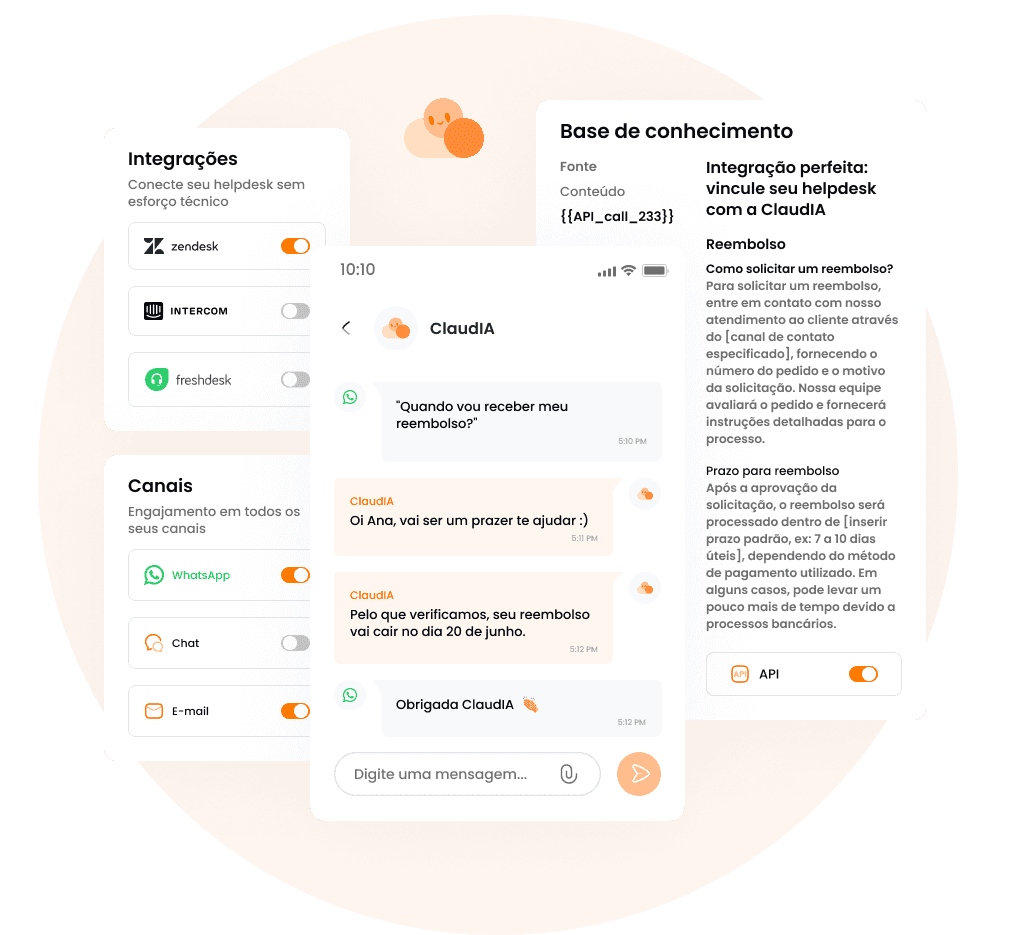
In addition to responding, an AI agent can consult knowledge bases, follow policies defined by the company, execute actions in internal systems, and, when necessary, make a handoff to human service with clear context, history, and intention. The result is a more fluid, less repetitive service that actually reduces operational effort instead of merely redistributing it.
When the decision tree is still better
Despite the limitations, decision tree-based chatbots work better when the problem is simple, predictable, and low variability. Therefore, this model is often sufficient when:
The volume of inquiries is low or moderate, with little variation in how customers ask questions.
The processes are fixed and well-defined, with few exceptions or conditional decisions.
The bot's objective is only triage or routing, not complete resolution.
The team is small and needs something easy to control, even if limited.
There is a need for extreme control over the response, whether due to regulatory risk, compliance, or lack of mature AI governance.
In these scenarios, the effort to implement and govern an AI agent may not pay off in the short term. A simple, well-designed flow with few paths can solve the problem without adding technical or operational complexity.
When the AI agent is clearly superior
The AI agent becomes the best choice when the operation ceases to be predictable and begins to handle volume, variation, and context simultaneously. In other words: when the problem is no longer “responding,” but solving end-to-end.
💡 McKinsey studies indicate that up to 70% of customer service contacts are repetitive, making rigid models difficult to sustain as volume increases.
This model stands out when:
There is a lot of repetitive contact volume, but with various ways to ask the same thing. The customer does not follow a script, and the bot needs to understand intent, not keywords.
The WhatsApp is the main channel of the operation, with high volume, urgency, and low tolerance for friction. Long menus and rigid flows quickly break the experience.
The response depends on context: order, contracted plan, customer history, prior status, or actions already taken in the conversation.
The service requires real actions, such as checking orders, generating invoices or PIX, opening tickets, changing registration, or following internal processes.
The goal is to reduce real N1 human, freeing the team for more complex cases, and not just “holding” the customer for a few seconds before transferring.
In these scenarios, trying to scale with a decision tree usually generates the opposite effect: more frustration, more exceptions, and more human tickets. The AI agent, on the other hand, can absorb variation, learn from use, and increase coverage over time — as long as there is governance, monitoring, and a well-designed handoff, of course.
Practical comparison: 8 criteria for decision-making
To help you decide which model works best for your operation, we brought below the main criteria that CX/Support leaders usually analyze before making a decision. Take a look!
Criterion | Decision Tree Chatbot | AI Agent |
Real coverage | Only resolves simple and predictable cases. Exceptions often fall on human service. | Resolves more end-to-end cases, even with variations in language and context. |
Maintenance | Done manually, requires constant updating of flows. Each exception becomes a new node. | Evolves with use and monitoring. Adjustments focus on base, policies, and intents. Thus, less structural rework. |
Customer experience | High friction when the customer deviates from the script. Long menus and “I didn’t understand” are common. | Smoother conversation, adapted to how the customer writes and asks. |
Implementation time | Quick at first, but grows in complexity over time. | Can take days to weeks, depending on the base and integrations, but starts off more complete. |
Integrations and actions | Limited or nonexistent. Generally informational. | Consults systems, executes actions, and follows real service processes. |
Scalability | When volume doubles, the complexity and maintenance effort double as well. | Scales better with volume and variation, maintaining the same base structure. |
Governance and risk | Total control over the response, but little flexibility. | Requires governance (policies, auditing, fallback), but allows a balance between control and autonomy. |
Cost and predictability | Generally a fixed cost, even with low real resolution. | Models vary (license, usage, or resolution), with the potential to align cost with results. |
The most common mistake: trying to “force AI” on top of a broken process
An AI agent does not fix structural issues in service. When the knowledge base is weak, no one measures results, and the handoff to the human team is confusing, AI ends up becoming the scapegoat. The discourse turns into "AI makes mistakes," when in practice, the process was already not functioning before.
💡 Not coincidentally, Harvard Business Review points out that about 70% of AI projects fail when they try to scale without a clear scope, consistent data, and governance.
This mistake usually appears when the company skips some steps:
automates without knowing what the main reasons for contact are;
does not define clear fallback criteria;
does not establish responsible parties for the evolution of the service.
The result is predictable: low resolution, customer frustration, and resistance from the internal team itself.
On the other hand, there are clear signs that the implementation has everything to succeed. Typically, these operations:
Have the top reasons for contact well mapped, especially at N1.
Have a minimum knowledge base, even if it is not perfect.
Define a project owner, responsible for metrics, adjustments, and decisions.
Maintain a continuous monitoring and improvement routine, looking at errors, escapes, and feedback from the human team.
When these elements are present, AI ceases to be a risky promise and becomes a predictable component of the operation. It is not about "turning on AI," but about building a system that learns, evolves, and delivers results over time.
How to implement it the right way (15–30 day plan)
Final recommendation: what to choose in your case
Frequently Asked Questions
What is the main difference between a tree chatbot and an AI agent?
Tree chatbots follow fixed flows and predefined rules. AI agents understand the customer's intent, consider context, and can adapt the response or take actions without relying on rigid flows.
Does a decision tree chatbot still work?
Yes, it works in simple and predictable scenarios, such as basic inquiries, triage, or fixed information.
Can an AI agent make mistakes in service?
Yes, like any system or human. The difference is that AI agents perform better with governance: clear limits, handoffs to humans, and constant monitoring. The most common mistake is deploying AI without a knowledge base or oversight.
Is it worth replacing a traditional chatbot with an AI agent?
It depends on the scenario. If the service is simple and the volume is low, a traditional chatbot may be sufficient. If there is high volume, WhatsApp as the main channel, and a need for end-to-end case resolution, the AI agent tends to deliver better results.
Does an AI agent replace the support team?
No. It reduces the volume of repetitive inquiries (N1) and frees the human team for more complex cases. In practice, AI acts as a scaling layer, not a total replacement.
Does implementing an AI agent take a long time?
Not necessarily. Many operations start with a pilot in a few weeks, focusing on the main reasons for contact. The secret is to start small, measure results, and expand gradually.
Does the chatbot work well on WhatsApp?
Tree chatbots tend to create friction on WhatsApp because customers expect to converse, not navigate menus. AI agents adapt better to this channel as they understand natural language and the context of the conversation.
What to know if the chatbot is performing well?
Retention rate (cases resolved by AI), fallback rate to human, resolution time, complaints, and CSAT. If these indicators do not improve, automation is not making a real impact.